
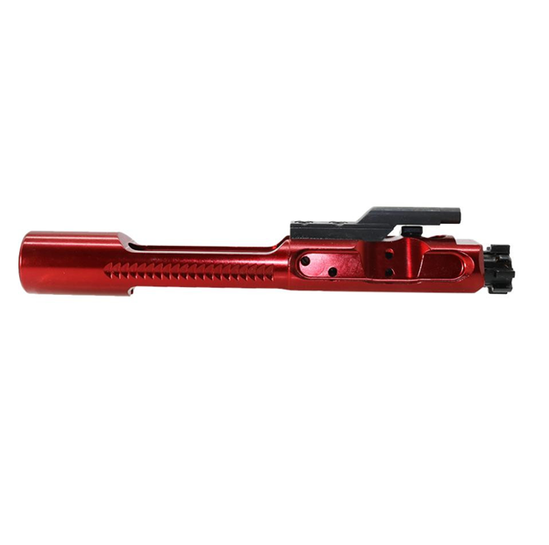
A rifle’s bolt carrier group, AKA its BCG, is often referred to as its beating heart. This analogy is not too farfetched, especially considering that it’s the component that physically feeds the chamber, then fires, extracts, and ejects the spent casing.
But before you buy another 5.56 or .300 Blackout BCG, read up here. We’re going to break down the parts and explain what they do.
What Is a Bolt Carrier Group?
A bolt carrier group is a metal housing that carries the bolt. It strips rounds off the magazine, feeds them into the chamber, fires them, and then extracts and ejects them.
The bolt carrier group also communicates with the rifle’s gas system through the gas ring and gas key, enabling the gas impingement system to cycle the BCG semi-automatically (or in the case of the rifle with select fire, automatically).
So let’s take a closer look at what the parts of a bolt carrier group actually are.
The Parts of a BCG
- Bolt: The bolt itself is a relatively small part housed within the front of the bolt carrier group. In an AR BCG, the bolt is a rotating bolt with a star-shaped pattern at the front that has 7 locking lugs. When the bolt engages, it rotates about 15° and locks into place to ensure a safe discharge before rotating to unlock once the round is fired.
- Bolt carrier: The bolt carrier is the largest part of the BCG and is the metal housing that actually contains the bolt and all of the other constituent components that are listed here. The bolt carrier is made from forged steel for durability and strength, and adds mass to the action, absorbing much of the force of recoil. It is also the component that communicates with the buffer weights and spring, cooperating with the buffer tube system to cycle the action and return it to battery once a round has been fired and the bolt moves to the rear under the pressure of gases.
- Extractor: The extractor is a claw-like component that hooks onto the rim of a cartridge as it is fed into the chamber. When the round is fired, the extractor pulls the cartridge free of the chamber so it can be ejected.
- Ejector: The ejector is a spring-loaded component housed within the bolt head that actually is responsible for ejecting the spent case free of the action through the ejection port. It works with the extractor to clear the action after a round has been fired.
- Cam pin: The cam pin is a critical component that makes sure the bolt carrier group does not over-rotate when the bolt unlocks. The pin rides in a cutout on top of the BCG and has a hole that allows the firing pin to pass through it, so that the action isn’t affected by the rotation of the BCG.
- Gas key: The gas key is mounted on top of the BCG and communicates directly with the gas tube. When a round is fired, pressure builds in the bore, and gases are siphoned through the gas block, through the tube, to the BCG’s gas key, forcing the bolt to rotate and unlock so that the action can cycle.
- Gas ring: The gas rings work in tandem with the gas key, trapping the pressurized gases so that they work to cycle the BCG, rather than just being vented off inside of the upper receiver. When the gas ring wears out, cycling will become sluggish and inconsistent.
- Firing pin: The firing pin is the component that actually strikes the primer, igniting the propellant in the cartridge case. When at rest it barely protrudes from the head of the bolt. In an AR, the firing pin is free-floating; when the hammer is cocked and then released, it strikes the back of the firing pin, sending it forward into the primer and firing the cartridge.
- Firing pin retainer: Because the firing pin in an AR is free-floating, it is retained by a small part called the firing pin retainer that prevents it from falling out of the bolt carrier group.
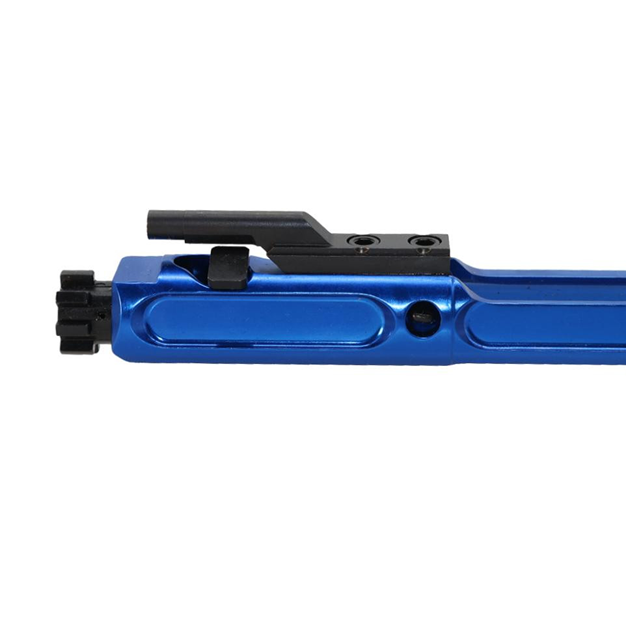
Here you have the parts of an AR-15 bolt carrier group broken down, which are common across all calibers. Whether you build a 5.56 or a 7.62 or are looking for a .300 Blackout bolt carrier group, the BCG should contain all of these parts.
Here for a .300 Blackout BCG?
Our collection contains numerous bolt carrier groups for different calibers. In addition to 5.56 and .300 Blackout BCGs, we also carry lightweight bolt carrier groups and BCGs with various advanced coatings that reduce wear, streamline cleaning, and most importantly, reduce friction as a result of their permanent dry lubricity. Explore our collection and get in touch with us at Sales@MCSGearup.com if you have any questions.