
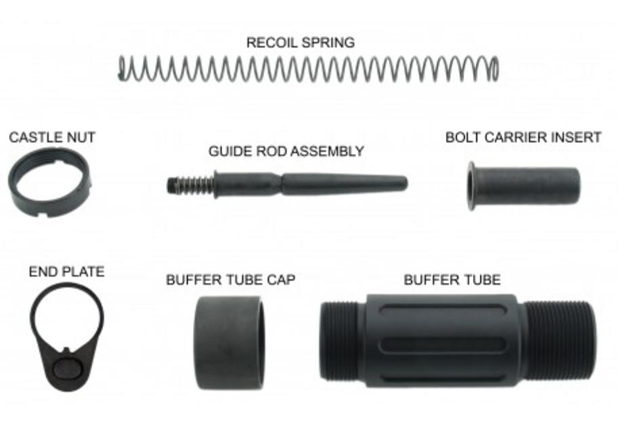
Like a recoil-operated or blowback action, an AR has a recoil spring (in this case, referred to as a buffer spring) that is responsible for storing the energy necessary to return the BCG to battery when the action cycles.
Unlike recoil and blowback operation, the direct gas impingement action of an AR requires a weight or a series of weights in the buffer tube to help soften the recoil and absorb some of the force before the buffer spring takes over.
That said, this article will explore the most common AR buffer tube weights along with what the effects are of lightening or increasing the buffer weight.
A Heavier Buffer
You can, within reason, install a heavier buffer weight in your rifle in order to soften recoil, all without adjusting the gas system.
The main effect of a heavier buffer weight is that you will cut the force of felt recoil. In addition, a heavier buffer will slow down action cycling slightly, all things considered.
A heavier buffer may also reduce wear on parts, specifically the buffer spring. It may also help reduce certain cycling malfunctions.
For these reasons, a heavier buffer weight may be advisable on rifles that are overgassed (and most rifles are overgassed from the factory).
A Lighter Buffer
Conversely, there may be situations in which a lighter buffer weight is necessary. Chiefly, if you lower the buffer weight, you will reduce the mass that absorbs the forces of recoil, and therefore apparent felt recoil will increase.
You might also opt for a lighter buffer weight if you are shooting lighter ammunition or you want to speed up the cyclic rate of the rifle. If the rifle is undergassed and you either can’t or don’t know how to adjust the gas system, a lighter buffer weight may also be preferable.
Some issues may also be rectified by a lighter buffer weight. Namely, if you have a rifle that is short stroking, a lighter buffer weight may be able to address this issue
Generally, though, you would be looking at a lighter buffer weight if you were shooting lighter ammunition, primarily ammo loaded with lighter bullets, as a lighter buffer weight will generally deliver greater reliability under those circumstances.
What Are the Most Common AR Buffer Tube Weights?
First, it’s important to note that AR buffer tubes vary in length. The two main lengths are carbine buffers and rifle buffers. The former are shorter and the standard for the rifle buffer tube is an A2 buffer tube.
As for weights, we’ll start with carbine buffer weights, which are the lightest at 3 ounces. Assuming a 5.56 chambering, a 3 ounce carbine buffer weight offers pretty solid reliability with most gas systems, ammunition types, bullet types, and barrel lengths.
The standard rifle buffer weight is known as an H or H1 buffer weight, and will weigh 3.8 ounces. This is a common weight that works well with a 5.56 chambering, most barrel lengths, and most bullet weights and types.
For rifles in heavier chamberings, an H2 buffer weight, which will typically weigh between 4.6 and 4.7 ounces, may be necessary. This type performs well with mid-length gas systems and can typically help tame rifles that are violently extracting.
An H3 buffer weight, which will typically weigh between 5 and 5.4 ounces, is the next step up. These heavier buffer weights tend to perform well with heavier cartridges like 7.62x39 ARs and .300 Blackout rifles. It will help control recoil and smooth cycling.
Lastly, we have pistol buffers, which weigh anywhere from 5 to 8 ounces. While you might think that a pistol AR buffer tube would house a lighter weight, this is typically not the case, as many AR15 pistol uppers lack a gas system and house a heavier bolt carrier group, which in turn necessitates a heavier AR buffer weight to control recoil.
Notes for a Silent Recoil (Buffer) Spring
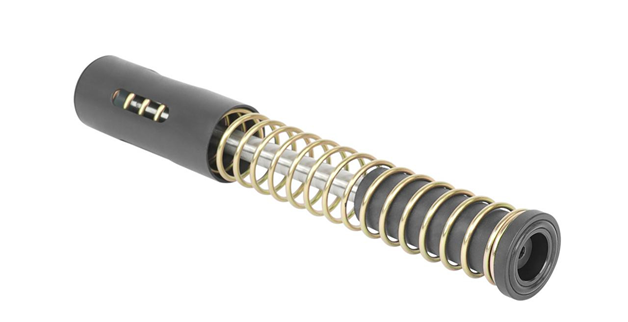
While not related to the buffer weight itself, the other integral component of the AR buffer tube is the buffer spring, which merits some notes.
Mainly, some buffer springs produce a loud and distracting “twang” noise when the rifle is fired. Some shooters find this distraction unwelcome and choose to upgrade their rifle with what is known as a silent buffer spring.
Consider that upgrade if your buffer spring is distracting or annoying you as a result of the noise it produces when the action is cycling.
Shop AR Buffer Tubes and Kits Here
Here for a new AR buffer tube for an ARP build, or do you want to tinker with weights to tune the rifle? You’re in the right place. Hopefully you found this guide helpful; now, explore our collection of AR buffer tubes and other AR parts and if you have any questions about specification or compatibility, get in touch with us directly at Sales@MCSGearup.com.