
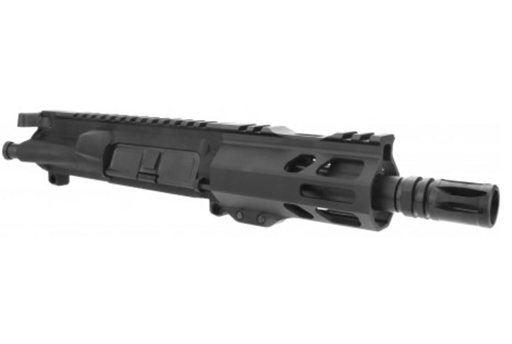
AR-15 complete uppers, assuming they come with a bolt carrier group, will have everything you need to pair to a lower in order to complete a functioning rifle.
But whether or not you should start with an assembled upper, or get a parts kit or buy everything individually is up to you. Here are some questions to ask yourself to get yourself closer to an answer.
- How comfortable am I with firearm mechanics?
If you understand what all of the parts in an AR-15 complete upper do, and how they work together, and where necessary, how to adjust them, then perhaps you know enough to buy the AR parts individually. But, if the answer is that you’re not very comfortable, it’s far easier and safer to start with an assembled upper rather than buying everything piecemeal.
- Do I really care about learning more about how the rifle works?
For some, building an AR is not just about a new rifle, but a practice in the pride of ownership as well as in an education in how the rifle works. If that matters to you, then it might be a good idea to start with separate parts. If it doesn’t, an assembled upper is a far more convenient option.
- Am I confident enough to pick out piecemeal parts?
Again, if you know how to pick out the parts you will need for the build, including the stripped upper itself, the bolt carrier group, the barrel, nut, and muzzle device, the gas system components, the charging handle, forward assist, dust cover, and handguard, then you can choose either avenue; go with the one that is most appealing to you.
- Do I know every part I need to assemble my own complete upper?
Some parts you don’t really need. For instance, you can build a rifle that works as intended without a forward assist. You don’t need a flash hider as long as you protect the threads. But, if you miss the charging handle, you can’t manually cycle the action, and if you get the wrong gas system components, the rifle will not function for what should be very obvious reasons.
- How much time do I want to spend on this build?
If time savings are important to you, then the best option by far is to go with an AR-15 complete upper. If you get a complete upper that comes with a bolt carrier group, it will have everything you need to pair it to a lower and can complete a functioning rifle in a matter of minutes provided you also have all the AR-15 lower parts you need. (Shop our collection of AR-15 lower parts kits for more information on that.)
- How much does convenience matter to me?
Just as an AR-15 complete upper can save you time with your project, for most builders it is also a lot more convenient to start with one than to get all of the parts individually. But, at the same time, if you like working with your hands, getting the parts individually and assembling them can be a good option. If it is legal in your jurisdiction, you might also want to start with a receiver blank, a drill press and a receiver blank jig. With these tools you can literally convert a receiver blank into a complete lower. With that, an AR-15 lower parts kit, and an assembled upper, you can complete the rifle.
- Am I going to customize anything or are stock parts good enough for me?
If you are going to customize parts, it might make more sense for you to get an upper parts kit or just buy all of the parts separately rather than starting with an AR-15 complete upper. Otherwise, you are going to end up with a lot of spare parts that you might not need, which is another consideration in its own right.
- If I’m going to make customizations, how many spares do I need?
If you are going to customize the rifle, there is one situation in which an AR-15 complete upper might actually make sense, and it’s if you want to have some spares around. For instance, if you are going to upgrade the BCG to one with an advanced coating like DLC or nitride, you can still keep the BCG from the complete upper as a spare or as a replacement for when the gas rings on your upgrade wear out.
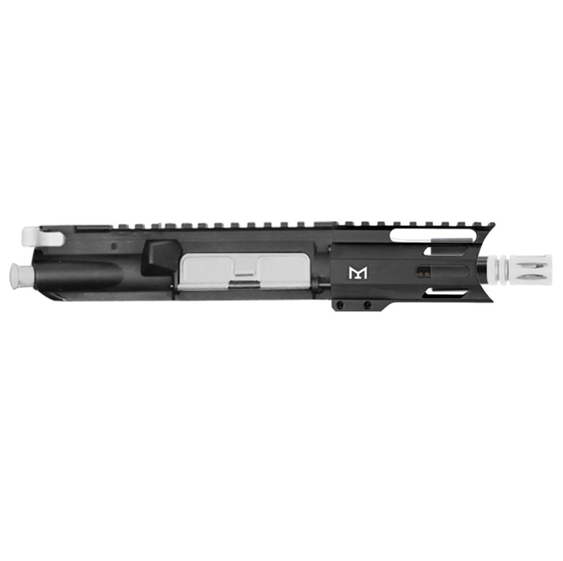
Shop AR-15 Complete Uppers, Parts and More Here
Looking for AR-15 complete uppers for your home build project? Check out our collection of assembled uppers, then take a look at our AR parts (which includes anodized and skeletonized parts, as well as ARP parts) to complete your project.