
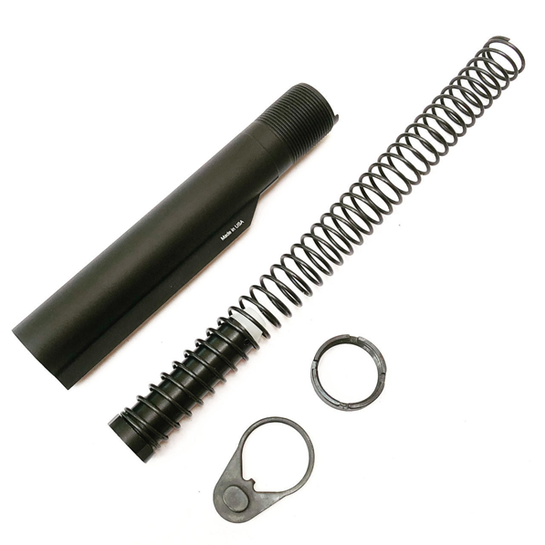
We sell a lot of AR parts here. Pretty much the only thing we don’t sell are finished lower receivers, since these require an FFL transfer. Everything else, we have it, whether it’s an upper, an assembled upper, a bolt carrier group, an AR15 charging handle, or even a buffer tube kit - or the whole system.
Speaking of which, these are among the least understood of all AR15 parts, so this post will hopefully demystify that aspect of gas impingement operation.
The Buffer Tube
The buffer tube itself is a fairly unimpressive part; it’s basically an aluminum tube that attaches to the rear of the lower receiver via a threaded interface. Generally 7075 or 6061 aluminum is used in the construction of a buffer tube. The former is preferred for its strength; this is the same alloy from which most AR upper and lower receivers are forged or machined.
The most common buffer tube, especially for fixed-stock builds, is the A2 buffer. Regardless, the tube houses the buffer weights and spring which interact with the buffer system once the rifle is fired and the bolt carrier group unlocks and moves to the rear as a result of the direct gas impingement action.
The Buffer Weights
Inside the buffer tube (and part of what will come with a buffer tube kit) there are a series of weights called the buffer weights. There are numerous different styles of weights that are used depending on the length of the barrel, the chambering, and other aspects of the build.
The buffer weights help absorb recoil and slow down the bolt carrier group as it moves to the rear through the cycling sequence. As a result they are a critical component of the buffer system that’s housed within the buffer tube.
There are several different weights that are common in AR builds. These are:
- Carbine buffer weights: 3 oz
- H or H1 buffer weights (AKA Heavy): 3.8 oz
- H2 buffer weights: 4.6 to 4.7 oz
- Rifle buffer weights: 5 to 5.2 oz
- H3 buffer weights: 5 to 5.4 oz
- AR pistol buffer weights: 5 to 8.5 oz
The interesting thing, as you can see, is that pistol buffer weights are the heaviest of the lot. There is a good reason for this.
You might think that in an ARP, you need less weight. Actually, since many rely on direct blowback rather than on a gas system, you need a heavier weight to help absorb recoil and result in a smoother, more reliable action.
There is no set standard for buffer weights, either. You can tune the weights as a part of the system to reduce recoil, result in faster or smoother cycling, or improve the performance of the rifle overall.
For instance, if your AR is chambered in a heavier-hitting round like .50 Beowulf or 7.62x39, one that produces more recoil, using an H3 buffer weight may be preferable because it will help offset recoil slightly.
Another thing to note is that as the barrel length decreases, a heavier buffer weight becomes more suitable. The shorter the barrel, the heavier the buffer weight should be, holding all else equal.
Heavier buffer weights will absorb recoil, but they also may not be as suitable with lighter or lighter pressure rounds. At the same time, lighter buffer weights may result in faster cycling at the expense of increasing recoil slightly.
The Buffer Spring
The buffer spring is an important component of the buffer system that performs two critical functions. One is that it, like the buffer weights, softens and absorbs recoil. The other, and more important, is that it stores the energy necessary to return the bolt carrier group to battery.
There are two basic types of buffer springs. These are rifle buffer springs and carbine buffer springs. They are very similar except that carbine springs are shorter and thereby designed to fit into smaller carbine-length buffer tubes.
One note here is that some shooters find the noise produced by the buffer spring to be annoying and distracting, and so some manufacturers make silent buffer springs.
Buffer Tube Kits: Putting It All Together
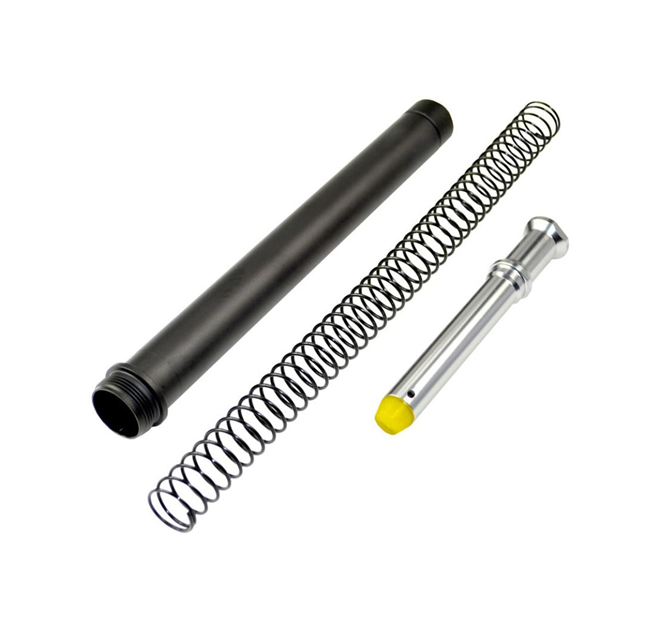
When you fire a round in an AR-15, gas builds pressure behind the bullet. Some of this gas gets siphoned off when it reaches the gas block, travels down the gas tube, and then reaches the bolt carrier group’s gas key. This unlocks the BCG and moves it to the rear.
As the BCG moves backwards, it encounters the buffer weights, which slow it down, along with the buffer spring, which also slows it down and which stores energy; once the BCG stops, the energy in the spring returns it to battery. That, in a nutshell, is how the buffer system works in conjunction with the gas system.
Shop Buffer Tube Kits and Buffer Systems
Thinking you might want to increase your buffer weights to reduce recoil, or that you need a new buffer system for a build? Shop our collection of buffer tube kits and other AR-15 parts and if you have questions get in touch with us.